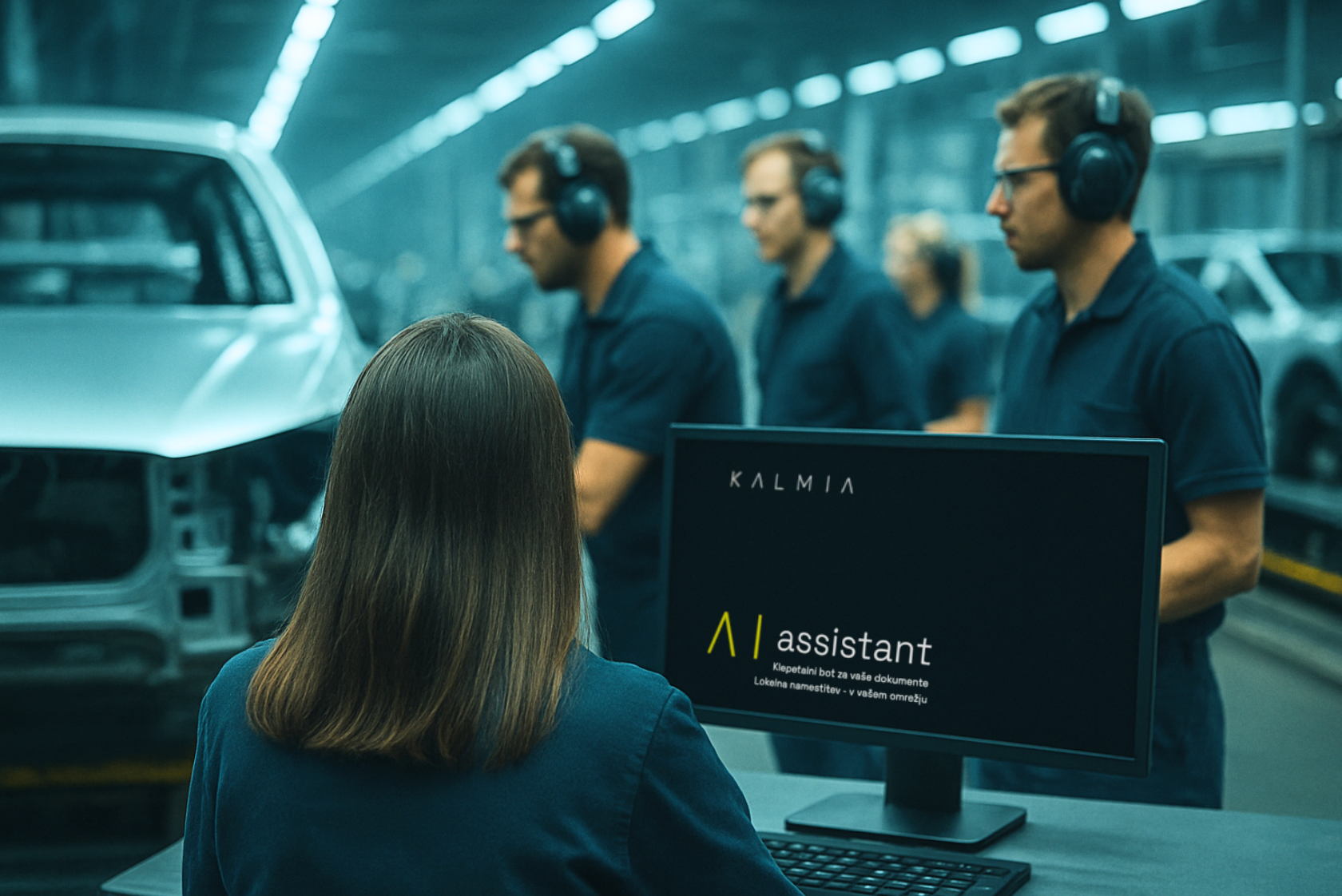
Today, industry doesn’t just revolve around machines – it revolves around information.
Where is something located? Who has the latest version of a document? Which parameter has changed – and has it been updated in all relevant documents?
These questions cause small delays measured not in seconds, but in lost focus and patience.
And this is the perfect environment for an AI assistant. It’s a tool that doesn’t replace humans – but helps them breathe between the lines of data.
It reads regulations, documents, and reports, answering questions that would otherwise flood the entire department’s inbox with emails titled: “Where can I find the latest version of the policy?”
Let’s explore three practical examples where an AI assistant becomes the quiet hero between work and coffee.
Understanding Policies and Procedures (Car Dealerships, Vehicle Inspections, Logistics)
Challenge:
Everyday questions that seem simple but take more time than they should:
“What is the minimum tire tread depth for commercial vehicles?”
“Who approves diplomatic license plates?”
Employees know the answers exist somewhere, but documents are scattered, versions change, and legal regulations can add confusion even for the most experienced staff.
How an AI assistant helps:
The assistant reads internal policies and legislation, then provides answers in natural language – fast and easy to understand:
“The minimum tire tread depth for vehicles over 3.5 t is 5 mm.”
If desired, it can also show which policy the information comes from.
You don’t just get the answer; you gain confidence that it’s correct.
Result:
Instead of 10 minutes searching through PDFs – it’s 10 seconds of dialogue with the AI assistant.
Managers know everyone is referencing the same sources – every employee has access to the same reliable information in seconds.
Faster Complaint Resolution (Food and Pharmaceutical Industry)
Challenge:
Complaints are part of any business – but the hardest part isn’t the error itself, it’s tracing its source.
Data is scattered across ERPs, lab records, Excel files… so finding information often requires a manual approach: clicking and reading documents.
How an AI assistant helps:
Employees can ask the AI assistant:
“Which batches were produced on October 10?”
“Which supplier provided raw material for batch 214-B?”
The assistant reads the related documents and connects the dots in a clear response.
It doesn’t manipulate the data; it understands it and presents it in a way that employees can use immediately.
Result:
Complaint resolution becomes a matter of minutes, not hours.
Quality control finds the root cause faster, and production teams can focus on solutions – not hunting through files.
Assisting with Report Preparation (Plastic, Metal, or Electronics Manufacturing)
Challenge:
Technologists and plant managers regularly need to prepare reports on scrap, efficiency, and material usage.
Most time isn’t spent analyzing data, but on gathering it, copying numbers, and verifying their accuracy.
How an AI assistant helps:
Employees simply ask:
“Summarize production for line 3 last week.”
“What was the scrap rate for material X in the last two months?”
The AI assistant reads existing documents and tables and summarizes the results.
“Line 3 achieved 94% of planned efficiency last week. The highest scrap was for material X (4.2%).”
Result:
Less administrative work, fewer errors, and more time for improvement.
Managers get up-to-date insights, while employees gain a clear sense of progress.
Check out three more practical examples where companies save more time than expected.
Making Knowledge Come Alive in the Company
The biggest impact of an AI assistant isn’t speed – it’s making knowledge a living part of operations.
What was hidden in documents becomes accessible through conversation.
The AI assistant works within your environment – safely and on data your company already owns.
It doesn’t require system changes – just space to do what it does best: answer questions, explain, and connect information into meaningful answers and patterns.
If you want to discover where an AI assistant could save the most time in your company, book a free AI consultation. Together, we’ll review your processes to identify “quick wins.”